
Artificial intelligence is becoming an increasingly common part of Realtors’ day-to-day work.
The findings come from the 2026 National Association of REALTORS® Technology Survey. In June 2026, NAR invited 73,718 randomly selected active Realtors to participate in an online survey, which received 1,165 usable responses. According to the survey, 67% of respondents said they are using emerging technologies such as AI but are still learning how to use them effectively. That’s up from 59% in last year’s survey, showing that more Realtors are exploring these tools as they become part of the industry.
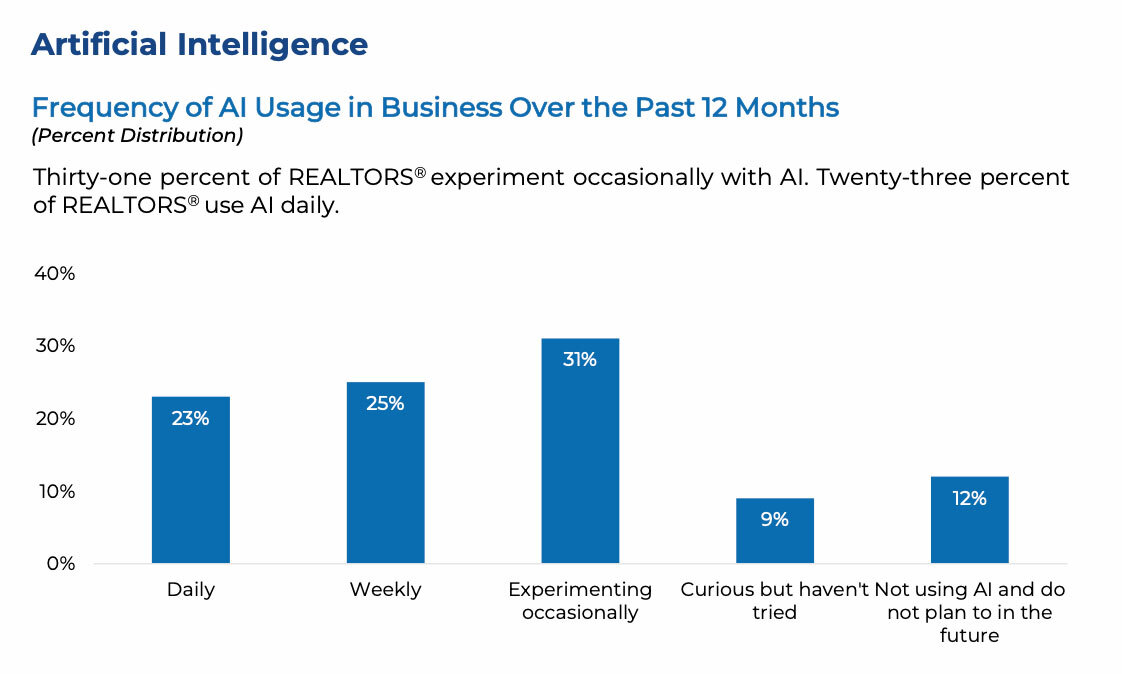
For many Realtors, AI is becoming a practical tool for handling everyday tasks and improving efficiency. More than half (55%) of respondents said AI has had a positive impact on their real estate business, while 23% reported using it daily and 25% reported using it weekly. That’s up from last year, when 20% said they used AI daily and 22% said they used it weekly.
Realtors are also reporting a more positive impact from AI compared with last year. In 2026, 39% of respondents said AI had a moderately positive impact on their business, while 34% said it had no noticeable impact. Last year, those figures were 23% and 46%, respectively, suggesting that more Realtors are starting to see the benefits of using AI in their businesses.
The biggest shift is in which AI tools agents are using. ChatGPT jumped from 58% last year to 91% this year, while Gemini rose from 20% to 42%, and Copilot from 15% to 27%.
The most common uses for AI tools include writing listing descriptions (75%), creating social media posts (56%) and drafting emails and follow-ups (52%).
Looking ahead, 54% of Realtors said they’re interested in using generative AI for content creation over the next year. Client relationship management tools followed at 51%, while 48% expressed interest in AI-powered lead generation and follow-up.
The share of Realtors who feel confident enough to teach others increased from 8% to 12%. Meanwhile, 14% said they have heard of emerging technologies but have not yet used them, down from 21% last year.
Even with the growing use of new technology, Realtors still face some challenges when adopting it. The learning curve was the biggest challenge cited by 63% of respondents, with cost following in second place, at 59%. Forty-four percent said there are too many options, making it hard to decide which technology is right for them.
Saving time continues to be the leading reason Realtors embrace new technology, with 81% citing it as a primary motivation in 2026, up from 66% last year. Improving the client experience was the second-most common reason, at 71%, compared with 64% in 2025, while 57% said they adopt new technology to help close more deals, up from 51%. Reducing manual work was also a factor for 54% of respondents, and 44% said staying ahead of the competition motivates them to adopt new technology, compared with 41% last year.
“Real estate agents are making practical choices about technology, and the two payoffs they want most are time and a smoother experience for their clients,” said NAR Deputy Chief Economist Jessica Lautz. “Those priorities have grown stronger over the past year. When routine work gets handled faster, agents have more time for the guidance, negotiation and steady advice that clients count on through a major financial decision.”